physverify
Check that a physics simulation solves the right equations, at the accuracy it claims, not just that it runs.
A simulation can run, draw nice plots and still be wrong: a minus sign in the wrong place, a factor of 2 missing, a time step that is off by one. Ordinary tests often miss these, because nobody knows the exact answer for a real simulation. physverify uses standard ideas from numerical analysis to check such code anyway, and explains each result in plain words.
pip install physverify
physverify demo
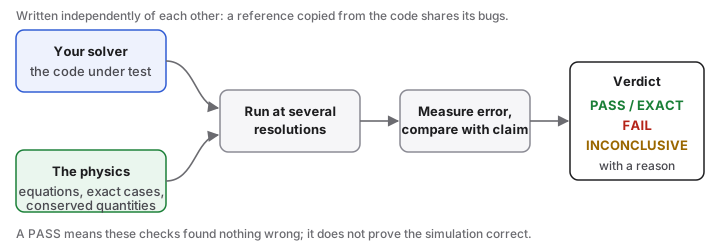
Run it on every push: add the GitHub Action to your workflow; a failed check fails the job.
      - uses: rcgiri-physics/physverify@v0.5.1
        with:
          specs: tests/verify_*.py
Before trusting a PASS, read What a PASS means: the checks are only as independent as the reference equations you write.
What it checks
| Check | The question it answers | Example |
|---|---|---|
| Manufactured solutions | Does the code solve these equations? | A midpoint method with a half-step typo |
| Order of convergence | Does the error shrink as fast as the method promises? | Hand in your own step sizes and errors |
| Reference solutions | Does it agree with an independent, more accurate solution? | A pendulum |
| Conserved quantities and budgets | Is energy kept? Does heat leak through an insulated wall? | Velocity Verlet, a 1D heat solver |
| Exact patch tests | Does it reproduce a solution it should get exactly? | A stage evaluated at the wrong time |
| Runge-Kutta tables | Do the coefficients have the order and stability their name says? | A table labelled order 3 that is order 2 |
| Exact references | Does it match a known closed-form result? | Morse oscillator energy levels |
| Statistics | Do the error bars mean what they say? Is a Monte Carlo sampler correct? | 68% intervals that cover 30% |
Every example on this site is a small script in docs/examples/, and the output shown is what it printed.
What a result looks like
mms        PASS   midpoint damped oscillator: observed order 2.04 (expected 2)
reference  PASS   midpoint damped oscillator: observed order 2.01 (expected 2)
mms        PASS   midpoint damped oscillator (whole trajectory): observed order 2.02 (expected 2)
patch      EXACT  midpoint damped oscillator: reproduced to round-off (largest error 2.7e-15), as designed
4 of 4 checks passed
Each check reports PASS, FAIL, EXACT (reproduced to round-off), INCONCLUSIVE (the errors could not be measured; the message says why), ERROR (the code crashed) or SKIP (an optional package is missing).
Does it work?
- On 37 bugs added one at a time to five small solvers, it caught 35, with no false alarms on the bug-free versions. The bugs and the checks were written by the same person, so this shows the tool works as designed; it is not a promise about other code.
- It was tried on 250 public physics repositories in a locked-down container and found confirmed bugs in some of them. The counts describe that sample only; see Results on real code.
Where to go next
- New here: Getting started, then How it works.
- Have a solver to check: Recipes.
- Want it on every push: Continuous integration.
Citing
If physverify helps your work, please cite it: doi:10.5281/zenodo.23534512 (all versions; each release also has its own DOI on Zenodo).
physverify is actively evolving (version 0.5.1), welcoming contributions and test cases from the computational physics community: see how to help and GitHub issues.